What EPCOT Was Supposed to Be: Walt's City of Tomorrow vs. the Park That Opened in 1982
Walt Disney's EPCOT was meant to be a city of about 20,000 renters, not a park. What his 1966 film promised American companies, why Disney built EPCOT Center instead, and what the 1982 park cost. Chapter 3 of The Florida Project.


Quick Answer: EPCOT, the Experimental Prototype Community of Tomorrow, was meant to be a real city for about 20,000 people, not a theme park. Walt Disney pitched it in a film shot in October 1966, weeks before he died, as a living showcase for American industry where nobody would own land. Disney built a park instead: EPCOT Center opened on October 1, 1982, at a reported cost of about $800 million to $1 billion, roughly $2.8 billion to $3.5 billion today.
20,000
residents planned for Walt's city
Sources: The Exhibitor, 1967; TouringPlans
7 weeks
from the film shoot to Walt's death
Sources: MousePlanet; WKMG News 6
$800M to $1B
EPCOT Center's reported cost, 1982
Sources: The Christian Science Monitor; D23
Chapter 2 covered Disney's deal with Florida. This one is about what Walt wanted to build on all that land, and why a theme park went up instead.
Walt's last film
In October 1966, Walt Disney filmed a pitch for the Florida Project, from a script by Marty Sklar, according to D23's history of the film. It ran about 25 minutes, and a trade paper later called it the last film Walt completed. He died on December 15, 1966, about seven weeks after the shoot. In early 1967 the film was shown to the Florida Legislature, to invited guests in Winter Park and once on statewide television.
A city of 20,000 renters
The star of the film was EPCOT, a real city for about 20,000 people. Walt called the layout the Radial Plan: rings of activity spreading out from a central hub.
The hub held shops, theaters and offices under one roof, so weather never mattered, with a hotel and convention center rising from the middle. Apartments ringed it, then a greenbelt for parks and schools, then neighborhoods of homes. The hub had no cars. Residents would ride PeopleMovers and monorails, and supply trucks would use tunnels underneath.
Then the unusual part. Everyone would have a job, and no one could own property. American Heritage sums up the trade-off: "No land ownership, and no voting rights." Residents would live inside the experiment without a vote on how it ran.
The Radial Plan, sketched
Shops, offices, a hotel and convention center, under one roof. No cars.
Parks, schools and recreation
What Walt offered companies
The business case was a stage. A 1967 trade report on the film's premiere called EPCOT "a living showcase for the creativity of American industry" that would never be finished, always "introducing, testing and demonstrating new ideas and new technologies." American Heritage reports that Walt met with firms such as General Electric, Westinghouse and RCA about making it a lab for their newest technology. The same 1967 report priced the whole Florida Project at "at least $600 million," about $6 billion today.
From the record
“With the technical know-how of American industry and the creative imagination of the Disney organization, I’m confident we can build a living showcase that more people will talk about and come to look at than any other area in the world.”
What got built instead: EPCOT Center
Roy O. Disney built Magic Kingdom first; that's chapter 4. In 1975, company president Card Walker announced EPCOT would go ahead, but he and his advisers judged Walt's city unrealistic. In D23's words, "one could not expect people to live under a microscope." A place couldn't be both a showplace and a home.
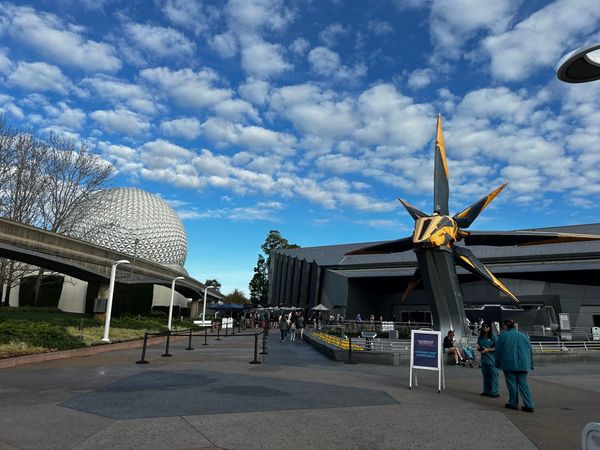
So the Imagineers built a park in two halves, Future World and World Showcase. EPCOT Center opened on October 1, 1982. That week The Christian Science Monitor called it "the $800 million project," and D23 puts it "in the neighborhood of $1 billion," roughly $2.8 billion to $3.5 billion today. Corporations helped pay, among them Exxon, General Motors, the Bell System, Kraft, Kodak and Coca-Cola, most of them sponsoring a pavilion tied to their products.
Walt's showcase for American industry got built. The city of 20,000 that was supposed to surround it never did. Chapter 4 follows Roy O. Disney as he finishes the job.
The receipts
| What | Then | Today, roughly |
|---|---|---|
| The whole Florida Project, as pitched in 1967 | $600 million or more | about $6 billion or more |
| EPCOT Center, 1982 | about $800 million to $1 billion | $2.8 billion to $3.5 billion |
Costs as reported in 1967 and 1982 and by D23. Adjusted with the BLS consumer price index (CPI-U), 1967 and 1982 averages to October 2026, rounded. Last Checked: November 15, 2026.
Sources
- The Exhibitor, February 15, 1967, via the Media History Digital Library (report on the Winter Park premiere)
- A World of Tomorrow: Inside Walt’s Last Dream, D23, 2012
- EPCOT, D23 Disney A to Z
- Walt Disney Passes Away, D23
- Disney’s Epcot: past, present, and future on parade, The Christian Science Monitor, 1982
- The Disney Utopia That Never Was, American Heritage, 2007
- The Epcot That Never Was, TouringPlans, 2015
- Walt Disney’s EPCOT ’66 film debut, MousePlanet, 2018
- Walt called it EPCOT: Disney’s real interest in Florida real estate, WKMG News 6, 2021
- Consumer Price Index for All Urban Consumers (CPI-U), U.S. Bureau of Labor Statistics, 2026