How Roy O. Disney Finished Walt Disney World, and How He Paid for It
After Walt died in 1966, Roy O. Disney put off retirement, named it Walt Disney World and built it for about $400 million, paid mostly with stock and bonds that became stock. Chapter 4 of The Florida Project.

Quick Answer: After Walt Disney died in December 1966, his brother Roy, then 73, put off retirement to build Walt's Florida project and insisted it be called Walt Disney World. The first phase, Magic Kingdom, two hotels and a monorail, cost about $400 million, roughly $3.3 billion to $3.7 billion today. Roy paid for it mostly by selling shares and convertible bonds, plus the company's own cash, rather than bank loans.
About $400M
for the first phase
Sources: D23; Business Week, 1971
$90M
in bonds that became stock by 1970
Source: Disney annual reports, 1969 and 1971
7 million
cubic yards of earth to move, 85% done by late 1969
Source: Disney annual report, 1969
Walt Disney died in December 1966, a year after he and his brother Roy announced the Florida Project in Orlando. Roy was 73 and ready to retire. Instead, he stayed on to see Walt's last project built.
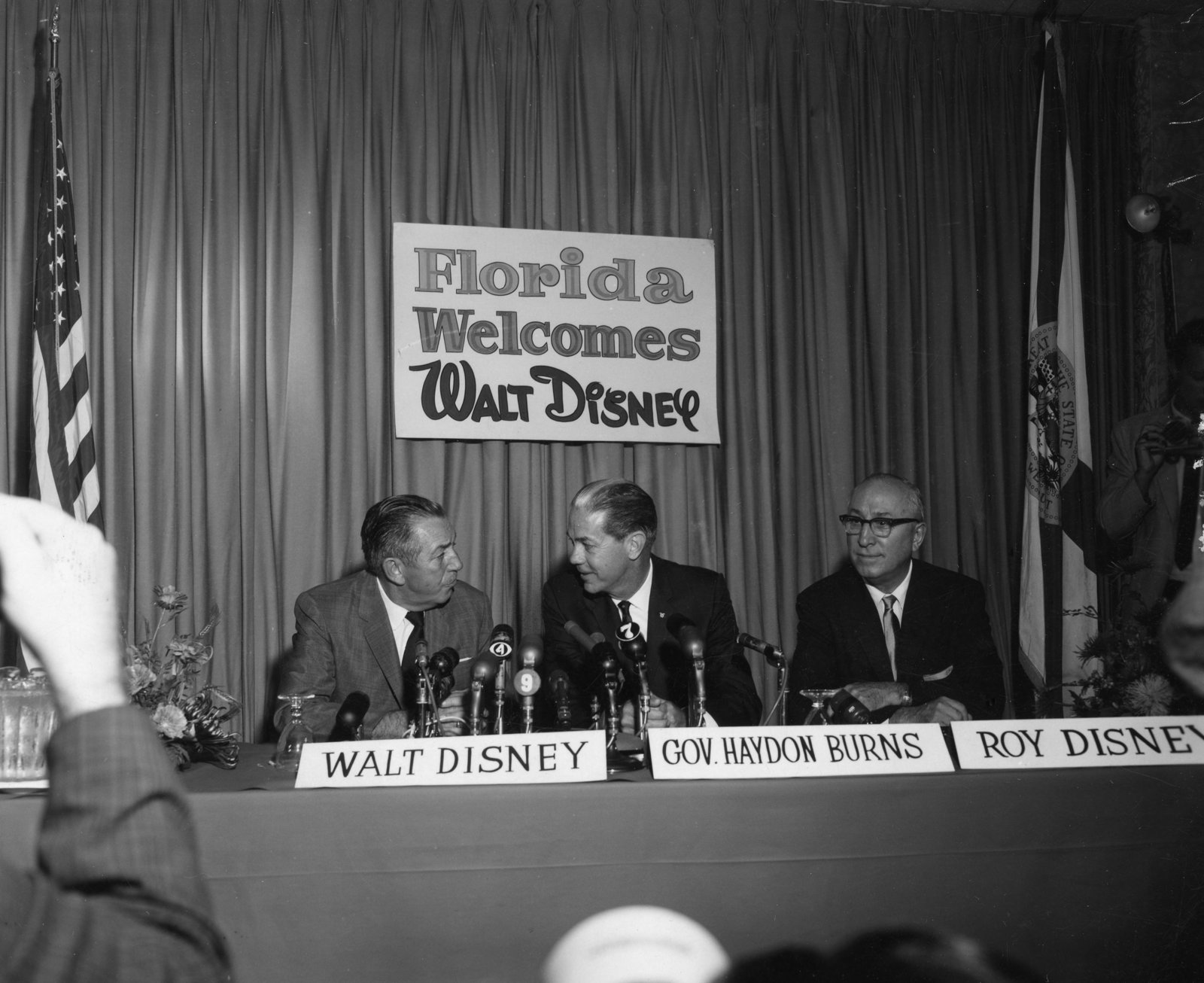
Roy stays, and puts Walt's name on it
He also settled the name. Disney World was the obvious choice, but Roy insisted on Walt Disney World. Card Walker, then the company's president, said in a 1973 interview that he fought him on it: “‘Disney World’ was a better title to market. But he said, ‘No, Card, I want it that way.’” Walker's read, as the Walt Disney Family Museum quotes him, was that Roy wanted “no misunderstanding” that this was Walt's project.
Start smaller, and build up a swamp
Walt's experimental city went on the shelf (chapter 3 tells that story). Roy's first phase was the part guests would pay for: Magic Kingdom, two hotels and a monorail to link them.
Disney broke ground in May 1967. The site was swamp and pine, so the first job was moving the land itself. By late 1969, crews had moved most of 7 million cubic yards of earth to build up the park and hotel sites and dig a 200-acre lagoon off Bay Lake, and 40 miles of canals were finished to control the water, says Disney's 1969 annual report.
The park sits on top of a basement. Tunnels under Main Street, Fantasyland and the rest of the park, the utility corridors fans call the utilidors, keep wardrobe, break rooms and deliveries out of sight. Fifteen years of Disneyland lessons put a third of the cost of the park and other recreation areas underground.
How Roy paid for Walt Disney World
In 1965 Walt had guessed “a hundred million plus” for the first phase. The bill came to about $400 million. In the 1971 annual report, Roy wrote that costs ran “substantially over our estimates, due mainly to inflation.”
His fix was to sell slices of the company rather than borrow against it. In 1968 and 1969 Disney sold $90 million in convertible bonds, loans the holder can swap for stock. The share price climbed, Disney called the bonds, and by October 1970 they had become stock, never repaid in cash. In January 1971 it sold 500,000 new shares at $148 each, about $70 million after costs. Cash from the films and Disneyland filled in, with a $50 million bank line kept in reserve.
D23 says the project opened “with the company having no outstanding debt.” That's not quite right. In June 1971 Disney sold $100 million more in convertible bonds, still owed when the gates opened. They were built like the others, though: each $127.45 of bonds could become a share that had sold for $148 that January.
Where the $400 million came from
The receipts
| What | Then | Today, roughly |
|---|---|---|
| First phase, 1967 to 1971 | about $400 million | $3.3 billion to $3.7 billion |
| Bonds, 1968 and 1969 | $90 million | $830 million to $870 million |
| New shares, 1971 | about $70 million | about $600 million |
| Bonds, June 1971 | $100 million | about $830 million |
Adjusted with the BLS consumer price index (CPI-U), each year’s average to October 2026, rounded; the first phase uses 1969 to 1971. Last Checked: November 15, 2026.
From the record
“We are trying to be practical and are determined to see Walt Disney World built and opened on a financially sound basis under present day conditions.”
He saw it open, just
Walt Disney World opened on October 1, 1971. On October 25, Roy dedicated it with a plaque thanking “the entire Disney organization that made Walt Disney's dream come true.” He died on December 20, 1971, about two months after opening, with the job he'd stayed for finished.
Chapter 5 goes back to October 1 and what that first day looked like.
Sources
- Annual Report 1969, Walt Disney Productions, 1969 (Internet Archive scan)
- Annual Report 1971, Walt Disney Productions, 1971 (Internet Archive scan)
- Walt Disney World Resort, D23
- Disney, Roy Oliver, D23
- 7 Rare, Vintage Images to Celebrate Walt Disney World Groundbreaking, Disney Parks Blog, 2024
- Roy Disney Made Walt’s Dream Come True After Walt’s Passing, The Walt Disney Family Museum, 2016
- How Disney financed its new superpark, Business Week, 1971 (via the DIX Project)
- 50 years ago, Roy Disney made Walt’s dream come true, WKMG News 6, 2021
- Consumer Price Index for All Urban Consumers (CPI-U), U.S. Bureau of Labor Statistics, 2026