How Disney Got Its Own Government: The Reedy Creek Story
In 1967 Florida let Disney's land run itself: the Reedy Creek Improvement District, two cities, its own building codes and bonds free of state tax. Who paid for the roads and drains, and what the first bonds raised. Chapter 2 of The Florida Project.

Quick Answer: In May 1967, Florida created the Reedy Creek Improvement District on Disney's land, plus two cities, Bay Lake and Reedy Creek (now Lake Buena Vista). The district could write its own zoning and building codes, run roads and utilities, and sell bonds free of state tax. The landowners, Disney above all, paid for it, starting with up to $12 million in drainage bonds approved in 1968.
May 12, 1967
the governor signs the act
Source: Chapter 67-764
1 vote
per acre to elect the board
Source: Chapter 67-764
Up to $12M
first drainage bonds, 1968
Source: Florida Supreme Court
By the end of 1965, Walt Disney Productions owned more than 27,000 acres southwest of Orlando. The land let Disney decide what to build. It didn't let Disney decide the rules for building it.
Why owning the land wasn't enough
Those acres sat in Orange and Osceola counties, which meant county zoning, county permits and county roads, with water and power on someone else's timetable. A theme park could live with that. Walt's bigger idea couldn't: EPCOT, a working city meant to keep testing new materials and systems, needed building rules that could change as fast as the ideas.
So the ask grew from permits to a government of Disney's own, offered in trade for that city of tomorrow. D23 notes that the district's first building codes were drawn up with Walt's EPCOT plans in mind.
Walt's pitch, shown after he was gone
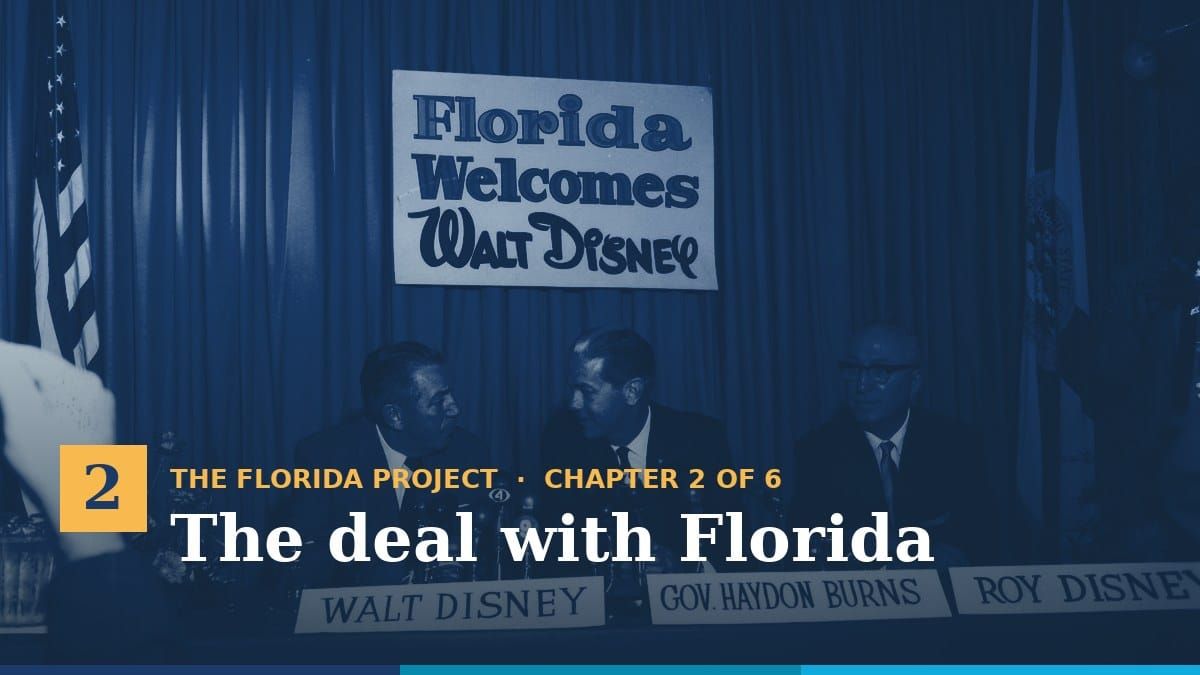
Walt filmed his EPCOT presentation in October 1966 and died on December 15, about seven weeks later. So the film made his case without him. On February 2, 1967, it played to a standing-room crowd at the Park East Theatre in Winter Park, with nearly half the state legislature in the seats, according to Jim Korkis's account of the night. That evening, Roy O. Disney and Governor Claude Kirk made the case to the whole state in a half-hour televised report.
What the 1967 act let the district do
Kirk signed it on May 12, 1967. Chapter 67-764 turned an old drainage district into the Reedy Creek Improvement District, and the same legislation created two cities inside it, Bay Lake and Reedy Creek, later renamed Lake Buena Vista.
We read the act itself, and its one-sentence title alone runs several pages. The district could write its own zoning and building codes, with county codes left out unless its board opted in. It could build and run water, sewer, drainage, roads, bridges, transit and even an airport, take on “experimental projects,” levy taxes and sell bonds whose interest Florida couldn't tax.
What the district could do
Its own zoning and building codes
Water, sewer, drainage, flood control
Roads, bridges and transit
Utilities and an airport
Experimental projects
Taxes, and bonds free of state tax
Five supervisors ran it. Every one had to own land in the district, and landowners elected them by the acre, which in practice meant Disney picked the board.
From the record
“At all elections of supervisors, each landowner shall be entitled to one (1) vote in person or by written proxy for every acre of land and for every major fraction of an acre owned by him in the District.”
Who paid for the roads and drains
The deal didn't hand Disney public money. The district paid for its canals, roads and utilities by taxing and charging the landowners inside it, with the main property tax capped at 30 mills, or 3% of assessed value, a year. Disney's own account says those landowners, primarily Walt Disney World, were “solely responsible” for the bill.
The first big borrowing shows how it worked. The district sought up to $12 million in drainage bonds to drain and reclaim its wet land, roughly $110 million to $120 million today. On November 27, 1968, the Florida Supreme Court approved them, noting Disney was the district's largest landowner and that the bonds would be repaid from drainage charges, not taxes.
The receipts
| What | Then | Today, roughly |
|---|---|---|
| First drainage bonds, 1968 | up to $12 million | $110 million to $120 million |
Adjusted with the BLS consumer price index (CPI-U), 1968 average to October 2026, rounded. The bond figure is the ceiling the court approved. Last Checked: November 15, 2026.
In February 2023, Florida took control of the district, renamed it the Central Florida Tourism Oversight District and gave the governor the power to appoint its five-member board, the Associated Press reported. The city those first codes were written for is chapter 3.
Who sits on the board, then and now
1967: Reedy Creek Improvement District
5 supervisors, all landowners, elected by landowners at one vote per acre.
2023: Central Florida Tourism Oversight District
5 members appointed by the governor. No one who worked or contracted with a theme park in the past three years.
Sources
- Chapter 67-764, Laws of Florida, as printed by the district
- RCID Created, Central Florida Tourism Oversight District
- State v. Reedy Creek Improvement District, Supreme Court of Florida, 1968
- A World of Tomorrow: Inside Walt’s Last Dream, D23, 2012
- Walt Disney passes away, D23
- Walt Disney’s EPCOT ’66 Film Debut, MousePlanet, 2018
- Walt called it EPCOT, WKMG News 6, 2021
- Years of fruitful relations between Disney, Florida at risk, Associated Press, 2022
- DeSantis signs bill giving him control over Disney district, Associated Press, 2023
- The Value of Disney Reedy Creek to Florida, Disney, 2023
- Chapter 2023-5, Laws of Florida, 2023
- Consumer Price Index (CPI-U), U.S. Bureau of Labor Statistics, 2026