The Walt Disney World Monorail: The Complete Guide, From Walt's Idea to Today's Fleet
From a test track near Cologne to Disneyland's 1959 "Highway in the Sky" to the 12 Mark VI trains running today: the full story of the Walt Disney World monorail, how its three lines work, every train by color, and when it's the fastest way around.

Quick Answer: The Walt Disney World monorail grew out of Walt Disney's fascination with a German test track in the 1950s, which became Disneyland's monorail in 1959 and Walt Disney World's opening-day transportation in 1971. Today 12 Mark VI trains, each known by its stripe color, run three free lines linking Magic Kingdom, EPCOT, the Transportation and Ticket Center and three resort hotels. Disney hasn't announced replacement trains, so the Mark VI fleet is still the one you'll ride.
Most things at Walt Disney World need a ticket. The ride a lot of families take first doesn't: a six-car train that pulls out of the Transportation and Ticket Center, swings around the Seven Seas Lagoon and glides straight through the middle of a hotel. It's been doing roughly that since October 1, 1971, and the idea behind it is older than the resort.
It started with a train on a single beam in Germany
Walt wanted a monorail before he had one. In Imagineer Bob Gurr's telling, a monorail was in the very first batch of Disneyland ideas, drawn as a train hanging from an overhead rail. On a 1952 trip to Germany, Walt and Lillian Disney rode an early monorail, and the story goes that Lillian asked why the cars couldn't run on top of the track.
A company called Alweg, named for its founder Axel Lennart Wenner-Gren, was already working on that. Since 1952 it had run a test monorail near Cologne on a curving beam about a mile long, with the train straddling the beam rather than hanging from it.
Accounts differ on exactly when Disney found it. The Walt Disney Family Museum says Walt noticed a monorail train on a trip to Germany and immediately saw it as the transportation system of the future. The American Society of Mechanical Engineers dates the formal visit to the summer of 1957, when Disney's engineering group examined the Cologne track, with Disneyland and Alweg joining forces in the summer of 1958 to build a working prototype.
1959: Disneyland's "Highway in the Sky"
Walt asked Gurr for something that looked like it belonged in Tomorrowland. Gurr sketched a Flash Gordon-style spaceship, erased the top wing and drew the old Viewliner cars trailing behind it. That became the Mark I: two trains, one red and one blue, with a bubble windshield up front for the pilot.
The Disneyland-Alweg Monorail System opened on June 14, 1959, with Vice President Richard Nixon and his family on hand. When the oversized ceremonial scissors refused to cut the ribbon, Walt ripped it in half with his hands. The Walt Disney Family Museum calls it "the very first daily operating monorail system in the Western Hemisphere," and D23, Disney's official fan club, calls it the first daily operating monorail in the country.
In 1961 the line reached the Disneyland Hotel with new Mark II trains, making it the first monorail in the country to cross a public street.
Why the monorail sits at the heart of Walt Disney World
Walt's Florida plans went well beyond a second Disneyland. His EPCOT idea, short for Experimental Prototype Community of Tomorrow, was a planned city with new kinds of transportation, and his vision of a monorail for EPCOT is why Walt Disney World got monorails. Walt died before he could refine those ideas, and his brother Roy decided to start with what the company knew how to build: a Magic Kingdom.
The 1971 resort was laid out around the train. Day guests parked (for 50 cents back then), rode to the Transportation and Ticket Center, and continued to Magic Kingdom by monorail or by boat across the Seven Seas Lagoon, so the trip to the gate was part of the show rather than a walk across a parking lot.
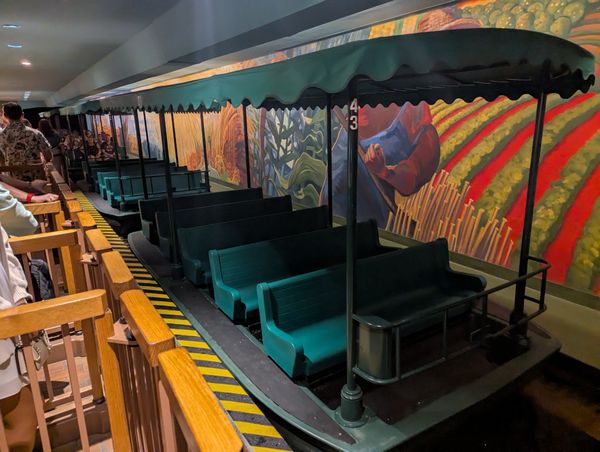
Hotel guests had it even better. Both original hotels opened with the resort on October 1, 1971: the Polynesian, with its own station across the lagoon, and the Contemporary, an A-frame built so the monorail glides right through it above the fourth floor, past Mary Blair's 90-foot mosaic murals in the Grand Canyon Concourse.
1971 to 1991: Mark IVs, the EPCOT line and the Mark VI
Opening day ran on Mark IV trains, a model designed for Walt Disney World and built by Martin Marietta. Ten entered service in 1971 and 1972, and two more joined in 1977.
The big expansion came with EPCOT Center. A separate line from the TTC to EPCOT opened on June 1, 1982, four months before the park itself opened on October 1, 1982. The Grand Floridian, which opened on June 28, 1988, gave the Resort loop its third hotel.
Then came the trains you ride today. Mark VI trains began replacing the Mark IVs in 1989, and the changeover was finished in 1991. They were built by TGI, a subsidiary of Bombardier, and each is six cars and 203.5 feet long. If you're wondering about the missing numbers, the Mark V and Mark VII were Disneyland trains, so Walt Disney World went straight from IV to VI.
Two hard days: the 1985 fire and the 2009 crash
In 1985, a flat tire caught fire under the rear car of Monorail Silver, then a Mark IV. About 40 riders in that car knocked out windows and climbed onto the roof, and Reedy Creek Fire Department lift trucks brought them and roughly 160 others down in an operation that took about an hour.
Accounts of injuries differ: Disney's spokesman at the time told reporters nobody had reported any, while later retellings put seven riders in the hospital for smoke inhalation and other injuries.
The 2009 crash was far worse. At about 2:00 a.m. on July 5, 2009, Monorail Pink, running empty, was being moved off the EPCOT line toward the maintenance shop. A switch-beam near the TTC hadn't been repositioned, so Pink backed up along the EPCOT beam itself and struck Monorail Purple as it approached the station. Purple's pilot, 21-year-old Austin Wuennenberg, was killed. The six guests aboard Purple weren't hurt. It was the first fatal crash in the system's 38-year history.
The National Transportation Safety Board found that the probable cause was the shop panel operator's failure to properly position the switch-beam, together with the failure of the monorail manager, filling in as central coordinator from off-site, to verify it before authorizing Pink's reverse move. It also faulted Walt Disney World's lack of standard operating procedures for reversing trains.
The changes Disney reported to the NTSB include pilots driving from the forward-facing cab when switching beams, a dedicated spotter for any reverse move, pilots visually confirming switch-beam position, video checks and a second operator at the switch panel, and coordinators directing trains only from inside the control tower.
The fleet changed shape too. Pink and Purple were retired, Disney built Monorail Teal from the undamaged parts of the two, and Monorail Peach, with two brand-new nose cones, entered service on October 7, 2011, bringing the fleet back to 12 trains.
Riding up front with the pilot is also gone. A 2012 answer on Disney's planDisney site said the experience had been discontinued a few years earlier and that "for safety reasons, guests are no longer permitted to ride 'up front' on the Walt Disney World Monorails!"
How the monorail works today
There are three lines, all starting from the Transportation and Ticket Center (TTC):
- Resort monorail: loops past Magic Kingdom, the Contemporary, the Grand Floridian, the Polynesian Village and the TTC.
- Express monorail: runs between the TTC and Magic Kingdom with no hotel stops.
- EPCOT monorail: runs between the TTC and EPCOT.
The Resort and Express trains start 30 minutes before Magic Kingdom opens and run until an hour after it closes. The EPCOT line starts 30 minutes before EPCOT opens and runs until two hours after it closes. Riding is free, and Disney's monorail page has the current details. By Disney's 2014 monorail release, as reposted by DisneyGeek, the lines cover about 14.7 miles of beam, and the trains ride a concrete beam just 26 inches wide.
It's an easy ride with kids and mobility devices. Wheelchairs and ECVs roll on, with a cast member setting out a ramp at each end, and strollers, even doubles, don't need to be folded. Disney treats medical strollers as wheelchairs. Leave glass at the hotel: glass containers of any kind aren't allowed on board.
When the monorail is fastest, and when it isn't
Staying at a monorail resort and heading to Magic Kingdom: the Resort loop is the obvious move, but it stops at every hotel. From the Contemporary, walking to the gate is often quicker, and the Grand Floridian has a walkway too. The Polynesian and the Grand Floridian also have boat docks on the lagoon, so you have a backup when the monorail line is long.
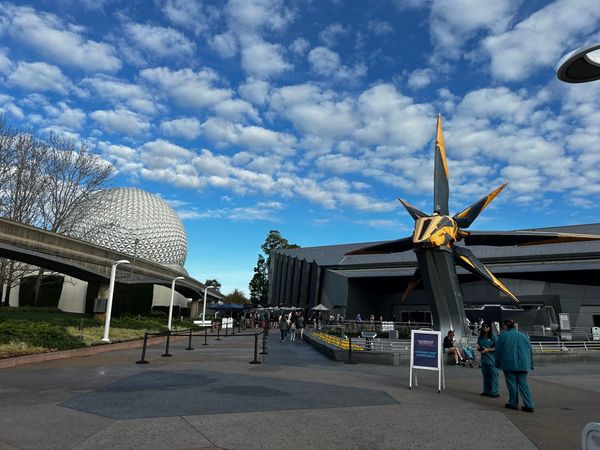
Heading to EPCOT from a monorail resort: there's no direct train. Ride the Resort loop to the TTC and change to the EPCOT line. The EPCOT line's two hours after closing means you don't have to rush out after the nighttime show.
Parking at the TTC for Magic Kingdom: take the Express, or the ferry across the Seven Seas Lagoon if you'd rather ride a boat.
Going to Hollywood Studios or Animal Kingdom: the monorail only serves Magic Kingdom and EPCOT, so you'll be on a bus, or the Skyliner from its resorts. Our ranking of resort transportation by time saved compares the monorail with the Skyliner and the buses, resort by resort.
The fleet, color by color
Every train goes by its stripe color, on the radio as well as in conversation: the scripted radio calls in Disney's monorail operating guide identify a train as "Monorail (Color)." Here's every Mark VI train, current and retired.
| Train | Status | Notes |
|---|---|---|
| Red | In service | Mark VI |
| Coral | In service | Teal deltas since 2021 |
| Orange | In service | Mark VI |
| Gold | In service | Mark VI |
| Yellow | In service | Mark VI |
| Lime | In service | Mark VI |
| Green | In service | Mark VI |
| Blue | In service | Mark VI |
| Silver | In service | Mark VI |
| Black | In service | Mark VI |
| Teal | In service | Built from Pink and Purple |
| Peach | In service | Since October 7, 2011 |
| Pink | Retired | After the 2009 crash |
| Purple | Retired | After the 2009 crash |
Colors from Disney's 2014 monorail release, as reposted by DisneyGeek, and the NTSB; Teal, Peach and the retired trains from WDWNT and Touring Plans. Last Checked: November 9, 2026.
The "deltas" in the Coral row are the contrasting shapes that break up a train's stripe. Coral picked up teal ones in a 2021 refurbishment, and other trains got new deltas in the same program.
What's next for the monorail
As of our November 2026 check, Disney hasn't announced replacement trains, so the Mark VI fleet is the one you'll ride.
What Disney has done is keep them going. All twelve went through an interior and door refresh that started in June 2019 and wrapped up with Monorail Lime in August 2022, and the trains gained a glowing nighttime lighting effect for Walt Disney World's 50th anniversary in 2021.
Monorail fun facts
- There have been seven monorail models, Mark I through Mark VII, across Disneyland and Walt Disney World.
- The Disneyland Monorail System was named a National Historic Mechanical Engineering Landmark in 1986.
- The Mary Blair mural the Contemporary's monorail passes is eight stories tall and has since been named "The Spirit of Peace Among Children."
- Before the monorail there was the Viewliner, a Tomorrowland train Gurr built partly from a 1954 Oldsmobile 88, split down the middle to fit its 30-inch-wide track. It ended service on September 15, 1958.
Counting the days until your next ride? Monorail Bounce is free in our Game Room. Its train is our own design, not Disney's, but the spirit is the same.